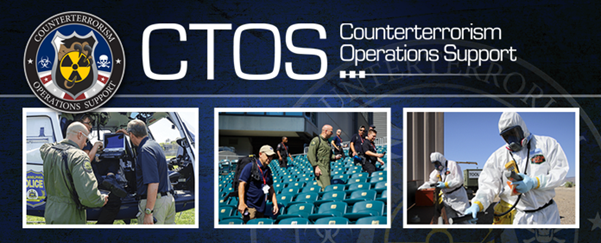
College Station and Richardson, Texas — As part of the National Domestic Preparedness Consortium’s (NDPC) mission to strengthen the Nation’s preparedness and response capabilities, Counterterrorism Operations Support (CTOS) program, in partnership with the Texas A&M Engineering Extension Service (TEEX), recently delivered PER-348: Response to a Radiological Dispersal Device (RDD) – Overview and Implementation of the First 100 Minutes Guidance to regional first responders and members of Texas Task Force 1 (TX-TF1) at TEEX Disaster City in College Station, Texas. Building on the success of that delivery, the CTOS instructional team is currently conducting the same training for Texas Task Force 2 (TX-TF2) in Richardson, Texas.
This training represents the type of specialized, high-consequence preparedness support the NDPC provides nationwide to ensure state and local responders are ready to operate safely and effectively during complex disasters and homeland security incidents. Texas Task Force 1 and Texas Task Force 2 are federally sponsored Urban Search and Rescue (US&R) Task Forces, part of the National US&R Response System that supports disaster response operations across the United States.
PER-348 prepares responders for the critical initial phase of a radiological or nuclear incident and was designed using the Radiological Dispersal Device (RDD) Response Guidance: Planning for the First 100 Minutes, developed by the National Urban Security Technology Laboratory (NUSTL). The course emphasizes practical, task-oriented skills aligned with national doctrine and real-world operational demands.
A distinguishing feature of the CTOS-delivered training is the use of actual radioactive material in a controlled instructional environment, providing responders with the most realistic hands-on training experience possible. NNSA’s CTOS program, through the NDPC, is the only provider nationally that delivers this level of realistic, hands-on radiological response training to the Nation’s first responders, ensuring participants gain firsthand experience with radiation detection, protective actions, and operational decision-making under authentic conditions.
Participants from fire service, law enforcement, hazardous materials, and search and rescue disciplines received training on responder missions and tactics during the first 100 minutes following an RDD detonation, radiation detection and protective actions, and victim monitoring and decontamination procedures. Training conducted at TEEX Disaster City leveraged a highly realistic disaster environment to reinforce coordination, safety, and effective response across disciplines.
“Delivering this training to federally sponsored Urban Search and Rescue task forces reflects the NDPC’s commitment to providing Congress-directed, capability-based training that directly supports national disaster response,” said David Pasquale, CTOS FEMA Manager. “USAR task forces deploy nationwide, and this training strengthens their ability to integrate radiological response considerations into complex operations.”
CTOS, a program of the Department of Energy’s National Nuclear Security Administration (DOE/NNSA), continues to support the NDPC by delivering advanced radiological and nuclear preparedness training that enhances national resilience and protects responders and the public.